Digital Circular Economy for Deep Tech AI Presentation
2026-06-11
Han-Teng Liao & Karen Ang
ICE 2026 / Special Session 08: Digital Circular Economy
Note: Welcome everyone. Today we look at the rapid scaling of Generative AI. The current industry standard is a linear, performance-at-all-costs paradigm. This approach focuses strictly on optimizing from electrons to tokens, but it completely externalizes major physical and ecological liabilities.
Note: This intensive scaling creates a massive collision with physical reality. In places like Taiwan, regional power distribution grids are already capping data center power expansions due to severe supply imbalances. Our study explores how a Regenerative Socio-Technical framework can prevent these sudden infrastructure crashes.
Note: The dominant industry model treats the data center as a basic factory line. The problem with this five-layer stack architecture is that it treats energy as a static, infinite utility input. Under Jevons Paradox, making tokens cheaper simply triggers an explosion in total macro energy consumption.
Note: To address this, we turn to the 2024 IEEE IRDS semiconductor facility roadmap. It details quantitative targets for water and chemical safety. However, a major knowledge gap persists: the industry lacks a way to bridge these static manufacturing parameters with live, operational AI workloads.
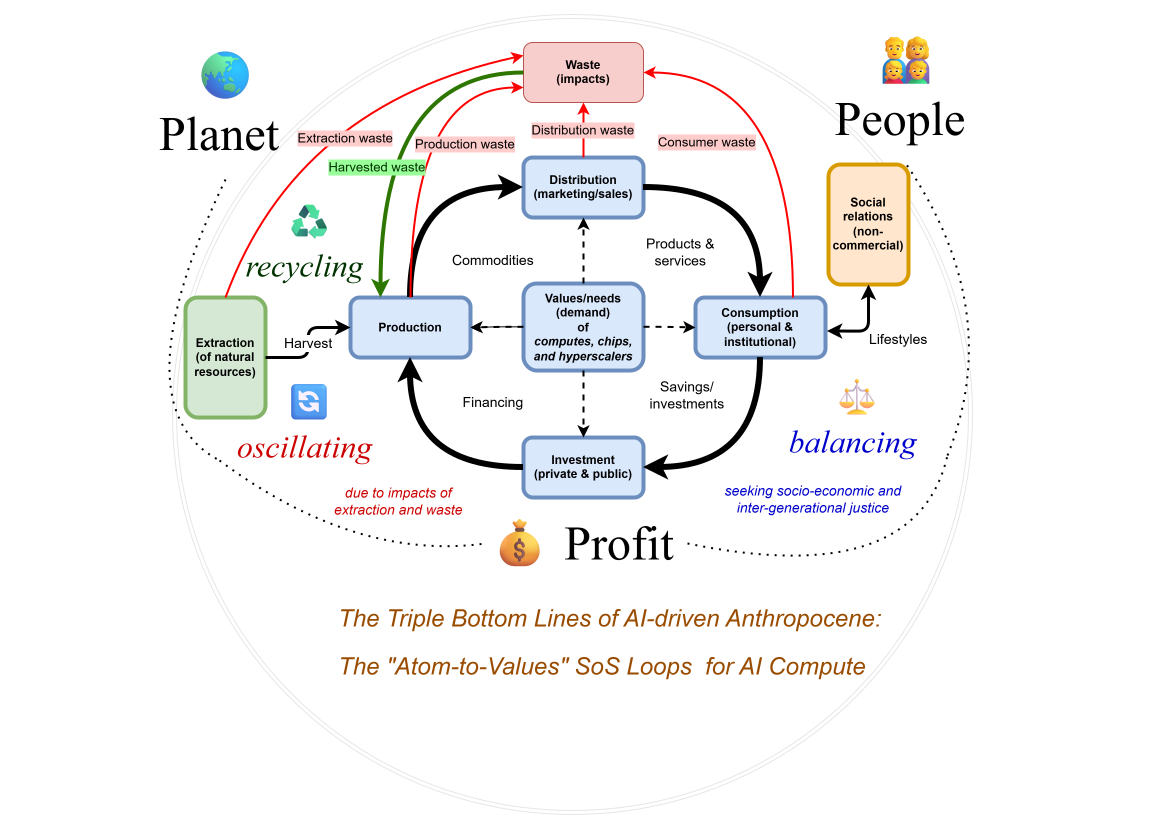
Note: Our methodology bridges this gap by repurposing the Sustainable Production and Consumption framework into a system dynamics model. This maps the lifecycle of compute into a Triple Bottom Line taxonomy, ensuring that the inner economic loops are structurally anchored by socio-technical governance and ecological limits.
Note: We apply design science research principles to build a circular reference architecture. By analyzing the structural limits of high-performance hardware, we transform sustainability requirements into real-world engineering constraints rather than treating them as standard, retroactive corporate social responsibility checklists.
| Layer | Functional Domain | Key Externalized Liability |
|---|---|---|
| L5 | Applications | Uncapped token demand generation |
| L4 | Models | Extreme memory capacity sprawl |
| L3 | Infrastructure | Cooling water depletion & grid volatility |
| L2 | Chips | Embodied carbon & short e-waste lifecycles |
| L1 | Energy | Extractive reliance on municipal grids |
Note: Let’s review our architectural findings. When we audit the standard linear stack, we expose massive externalized liabilities across every layer. Application demand drives the Jevons paradox rebound effect, while infrastructure layers trigger severe cooling water depletion and unbuffered regional utility grid strain.
Note: The root of these environmental liabilities is actually found at the micro-architectural silicon layer. The memory wall forcing model weights between high-bandwidth memory and registers creates severe thermodynamic friction. Falling below the minimum operational batch threshold causes the hardware to waste high baseline power while idling.
Note: This issue is amplified by long context windows, where Key-Value cache memory demands scale linearly. To accommodate this memory sprawl, operators are sharding workloads across massive, multi-GPU clusters purely to pool high-bandwidth memory space, resulting in low arithmetic utilization and intense resource consumption.
Note: This creates an acute engineering contradiction. Maximizing batch efficiency causes hardware memory faults, while down-batching traps the system in a high-entropy idling state. This drives a cycle of massive capital expenditure to build redundant hyperscale facilities that inherit the exact same operational flaws.
Note: To resolve this tension, our architecture implements an automated metabolic governor driven by the Systemic Volatility Indicator, or SVI. This dimensionless metric monitors both real-time micro-architecture utilization and localized utility grid stress, bounding performance based on regional infrastructure health.
Note: The SVI formalizes two core operational states. When under-batched workloads run during peak regional grid stress, the SVI approaches one, signaling severe eco-debt. When the system achieves full batch saturation during off-peak windows, the SVI drops to zero, indicating safe architectural homeostasis.
Note: Our reference architecture directly answers our primary research question by shifting the AI infrastructure paradigm from an extractive linear stack to an atom-to-values closed loop. Rather than treating waste heat and thermal entropy as ignored externalities, they are tracked as active balance-sheet liabilities.
Note: By deploying Digital Product Passports and regulatory technology, the reference architecture tracks the entire lifecycle of high-performance components. This allows operators to audit e-waste streams and automate compliance with strict international environmental laws like the EU’s Corporate Sustainability Due Diligence Directive.
Note: Crucially, our framework centers value creation around real human needs. This allows socio-ethical specifications, such as institutional human rights frameworks, to guide compute deployment. By doing so, it protects regional communities from labor exploitation and defends public civil resource sovereignty.
Note: For technology strategists and engineering managers, we translate these insights into a highly practical compliance checklist. Managers must actively align their workloads with local energy community capacities, structurally route facility waste heat, and utilize digital passports to extend accelerator lifecycles.
Note: We acknowledge certain limitations in our current work. The framework sits at an early technology readiness level and needs formal integration into standard global industry roadmaps. Future testing must include extensive field validation to ensure metadata integrity across real-world, global supply chains.
Note: In conclusion, this study contributes a system-of-systems reference architecture that tethers token generation to planetary boundaries. By introducing the Systemic Volatility Indicator, we prove that ecological debt can be successfully managed as an active software orchestration constraint.
Note: The real-world urgency of this research is highly visible. Right now, utilities are enforcing strict energy ceilings on new data centers due to grid imbalances. This confirms that technical efficiency gains cannot escape local biophysical limits, highlighting the urgent need for standardized circular governance.
Note: Our future work calls for an integrated roadmap across global standards bodies, expanding smart city frameworks into smart intelligence networks. Ultimately, advanced digital technologies require deep systems thinking. To make generative AI truly sustainable, we must govern it within the finite limits of our planet. Thank you.