flowchart TD
    A["🌍 <b>GLOBAL LANDSCAPE PRESSURES</b><br><font size=2>EU Green Mandates · CBAM Taxes · Geopolitical Shifts</font>"]
    B["🔒 <b>GBS AS AN OPERATIONAL AIRLOCK</b><br><font size=2>Translates Law, Tech & Sustainability Workflows</font>"]
    C["⚙️ <b>REGIONAL INDUSTRY MATURITY</b><br><font size=2>Top-Tier Regional Specialized Hubs<br>🇵🇱 Poland AI-Native · 🇵🇹 Portugal Green Tech · 🇲🇾 Malaysia GBS 5.0 & Chip Gateway</font>"]

    A --> B
    B --> C

    style A fill:#f9f9f9,stroke:#333,stroke-width:1px,color:#111;
    style B fill:#e6f3ff,stroke:#0058A2,stroke-width:2px,color:#002244;
    style C fill:#f9f9f9,stroke:#333,stroke-width:1px,color:#111;
    linkStyle default stroke:#0058A2,stroke-width:2px;
GBS for SSbD?
A Study Anticipating the Human-Agentic Opportunities for Sustainable Semiconductor and AI sectors
Research
Industry 5.0
Keywords
GBS, SSbD, Semiconductor, Industry 5.0, Twin Transition
Ten years after the classic Global Business Services (GBS) model was created, the rise of AI and advanced chipmaking requires a new approach. By looking at modern supply chains through both a social and technical lens, we show how a “Safe and Sustainable by Design” (SSbD) framework turns GBS centers into strategic control towers for Industry 5.0—proving that putting people and the planet first from the very start is simply good business.
Strategic Budget Questions for Global Leaders
When multinational corporations (MNCs) plan their global budgets today, they face a completely new set of questions:
- How do you invest in corporate functions when workflows are no longer handled just by local teams, but are woven together by global talent and autonomous AI agents?
- Where should you allocate capital when green regulations can stop your products from entering key markets overnight?
- How do you balance the cost of building advanced tech with the strict requirement to lower your carbon footprint?
The answer lies in reshaping your global business infrastructure to turn compliance from an expensive, box-checking burden into your primary engine for growth.
NoteThe Conceptual Core: From Cost to SSbD
Can Global Business Services (GBS) units move beyond their past as simple cost-cutting centers? Instead, they can become the main hubs that run a Safe and Sustainable by Design (SSbD) infrastructure for high-tech fields like semiconductors and AI. As global firms face heavy pressure to match high-power computing with green goals, a major shift is happening in how we manage technology and corporate operations.
1. Grounding the Paradigm: From KPMG 2016 to ID-306
Ten years ago, measuring how well a company ran its global operations depended on the KPMG 2016 Global Business Services Maturity Model (KPMG, 2016). That classic model showed companies how to move step-by-step from split-up, disorganized departments (Level 1) to a highly unified, strategic operation (Level 5) (KPMG, 2016). Back then, success meant streamlining internal areas like service portfolios, talent management, technology, process excellence, and team governance.
However, as outlined in our recent paper (Liao & Ang, forthcoming, 2026), focusing only on internal efficiency is no longer enough. Today’s businesses must survive major global disruptions, including the European Union’s green and digital mandates, the Corporate Sustainability Due Diligence Directive (CSDDD), and new carbon import taxes (CBAM).
Our updated framework redefines the modern GBS unit as an “operational airlock”. Instead of acting as a basic shared services department, the GBS setup acts as a protective shield. It insulates core corporate operations from messy global politics, changing laws, and sudden tech shifts.
The Extended SSbD Definition: Flipping a Burden into Growth
Our framework rewrites the rules by bringing an SSbD approach into KPMG’s 10 operational dimensions. We look at sustainability not as a final cleanup task done at the end of manufacturing, but as an upfront System of Systems (SoS) design rule. For semiconductors and AI, this means integrating data tools, precise environmental tracking, smart analytics, and ESG reporting right into the earliest planning stages.
By building safety and green metrics directly into daily workflows, compliance changes from a corporate headache into an active source of profit. Instead of dodging fines, an SSbD-enabled GBS unit builds high-value business advantages: it gets products into strict markets faster, qualifies the company for lower-interest green financing, secures steady supply chains, and delivers verified, low-carbon products that premium buyers demand. GBS shifts from a backward-looking records office into a forward-looking engine running both AI workflows and silicon supply chains.
2. Connecting Stakeholders: Insights from Figure 6 Canvas
To make an SSbD system work, a company cannot act alone. By combining data-driven science mapping with socio-technical transition theories, our framework uses a Stakeholder Engagement Tool Canvas (Figure 6) to show how modern industrial policies push global firms to change their technology plans.
This canvas maps out four operational threads that use AI and automation to solve shared ecosystem needs, bridging the gap between local talent and global networks:
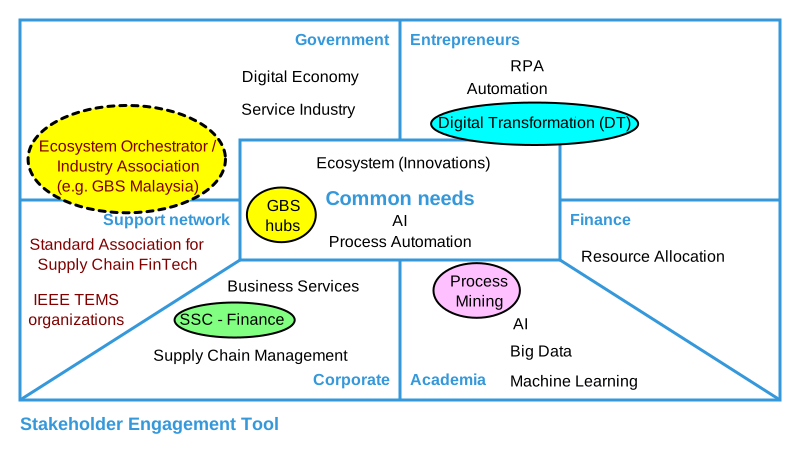
- 📜 The Policy-Compliance Thread (Government to Corporate): This maps how high-level global laws (like CBAM or CSDDD) are translated into daily corporate data standards. It upgrades the GBS unit from a basic back-office department into the official guardian of the company’s “license to operate.”
- 🎓 The Talent-Innovation Thread (Entrepreneur to Academia): This bridges the gap between fast-moving business needs and university research. It allows regional hubs to capture higher-value, specialized technical roles. In this thread, diverse hiring strategies and flexible hybrid work models serve as the vital foundation for data-driven talent decisions.
- 💰 The Reward-Orchestration Thread (Finance & Support Networks): This updates traditional shared finance services into advanced Supply Chain Finance. By integrating green financial technology (FinTech), regulatory software (RegTech), and automated auditing, the GBS hub can financially reward suppliers and partners who adopt green behaviors across the global value chain.
- 🧪 The Living Lab Thread (Entrepreneur to Corporate): This opens up corporate innovation. It gives internal teams and local startups a structured, safe sandbox to test new AI-native workflows before rolling them out across the entire multinational corporation. This breaks down information barriers and turns workforce retraining into a win-win game for both local talent and global leadership.
3. Real-World Proof from Three Key Nations
This stakeholder framework is not just theoretical; it is actively playing out across three vital geographic hubs, each proving how global business models are evolving.
🇵🇱 Poland: The Foundation for Reliable AI
The Polish ecosystem proves that you must clean up and standardize your data processes before you can use AI safely. Deploying advanced automation on top of messy, broken workflows simply multiplies your inefficiencies (ITSelecta, 2026). Data from the Association of Business Service Leaders (ABSL) shows that Poland’s business services sector has grown to over 2,000 centers employing more than 488,700 experts, shifting fast toward fintech and AI-native workflows (ABSL, 2025). This deep pool of human talent proves our Talent-Innovation theory: digital upgrades cannot rely on software alone; they require skilled local teams to guide complex organizational changes.
🇵🇹 Portugal: The Green Tech Regulatory Shield
Portugal serves as a live laboratory for blending green goals with digital tools. Backed by the national trade agency (AICEP), Portugal focuses heavily on attracting sustainable Centers of Excellence (CoE). The country now hosts around 270 business centers employing over 93,000 professionals (Oz, 2025). Crucially, ABSL Portugal reports that 84% of these centers are actively training their workers to handle advanced AI and ESG demands (ABSL Portugal, 2026). This high concentration of green-certified skills confirms our Policy-Compliance theory, proving that advanced GBS hubs protect global firms from regulatory penalties by running highly accurate eco-tracking systems (Liao & Ang, forthcoming, 2026).
🇲🇾 Malaysia: The Digital-Green Gateway for Semiconductors
As a major hub for the Asia-Pacific region, Malaysia provides the ultimate real-world proof of this new industry model. Led by the Malaysia Digital Economy Corporation (MDEC), the national “GBS 5.0” strategy builds a human-centric, AI-driven, and green-focused business ecosystem (PIKOM et al., 2025). Managing over 750 centers with more than 250,000 workers, Malaysia has successfully moved past old, low-wage business models (Liao & Ang, forthcoming, 2026).
We see this clearly in Penang, where projects like GBS@Technoplex are built to capture global AI growth and anchor digital innovation (InvestPenang, 2025). Because Penang is a vital physical link in the global chip-making and testing supply chain, its digital-first infrastructure (Liao & Ang, forthcoming, 2026) perfectly demonstrates our Safe-and-Sustainable-by-Design (SSbD) Chips Value Chain Services (SCVCS) model. It shows how software orchestration and shared data spaces can transform strict green rules into competitive advantages by tracking material lifecycles and recycling efficiency in real time.
4. Key Lessons for Global Strategy
- You Can Skip Steps: The old idea that a company must slowly climb from Level 1 to Level 5 is outdated. Modern business hubs can leapfrog over middle stages by using cloud-native software, reliable AI agents, and strict green rules from day one.
- Maturity is a Necessity, Not a Luxury: Achieving a highly integrated, automated, and compliant business hub is no longer just an expensive option. With global trade separating into rival political blocs, having a secure “operational airlock” is a basic requirement to keep your business running safely.
- Humans and AI Need Each Other: The data from Poland, Portugal, and Malaysia shows that automation will not wipe out human jobs (ABSL, 2025; ABSL Portugal, 2026; PIKOM et al., 2025). Instead, trust-based hybrid workplaces, data-driven talent development, and continuous retraining form the essential foundation that makes sustainable AI tools work.
Ultimately, designing your global business services for SSbD moves the entire field away from boring, backward-looking administrative tasks. It creates a proactive strategy focused on smart technology and planetary health. By linking global talent with industrial data hubs, these synchronized business centers protect global production networks, creating a resilient, sustainable future for global supply chains.
References
ABSL. (2025). Business Services Sector in Poland 2025. Association of Business Service Leaders.
ABSL Portugal. (2026). How AI & Automation are Shaping Tomorrows GBS Landscape.
InvestPenang. (2025). Penang Unveils the Development of GBS@Technoplex to Harness AI Growth and Cement Its Position as Malaysia’s Digital Innovation Hub (Uncategorized).
ITSelecta. (2026). AI & GBS in 2026: What is changing and why it matters? An interview with Romek Lubaczewski.
KPMG. (2016). The Global Business Services maturity model.
Liao, H.-T., & Ang, K. (forthcoming, 2026, forthcoming, 2026). Orchestrating the twin transition in multinational corporations: Technology roadmapping for green and digital global business services. 2026 IEEE International Conference on Engineering, Technology, and Innovation (ICE/ITMC). https://doi.org/10.31235/osf.io/ktcxd_v1
Oz, I. (2025). Business Service Centres in Portugal (3rd Ed.). AICEP.
PIKOM, GBS Malaysia, MDEC, & UNM. (2025). GBS Malaysia Strategy Mid-Term Report 2022-2027: Unleashing GBS 5.0 – Human-Centric, AI-Driven, Impact-Focused. PIKOM (Persatuan Industri Komputer dan Multimedia Malaysia); GBS Malaysia (Digital Global Business Services Council Malaysia); MDEC (Malaysia Digital Economy Corporation); UNM (University of Nottingham Malaysia).